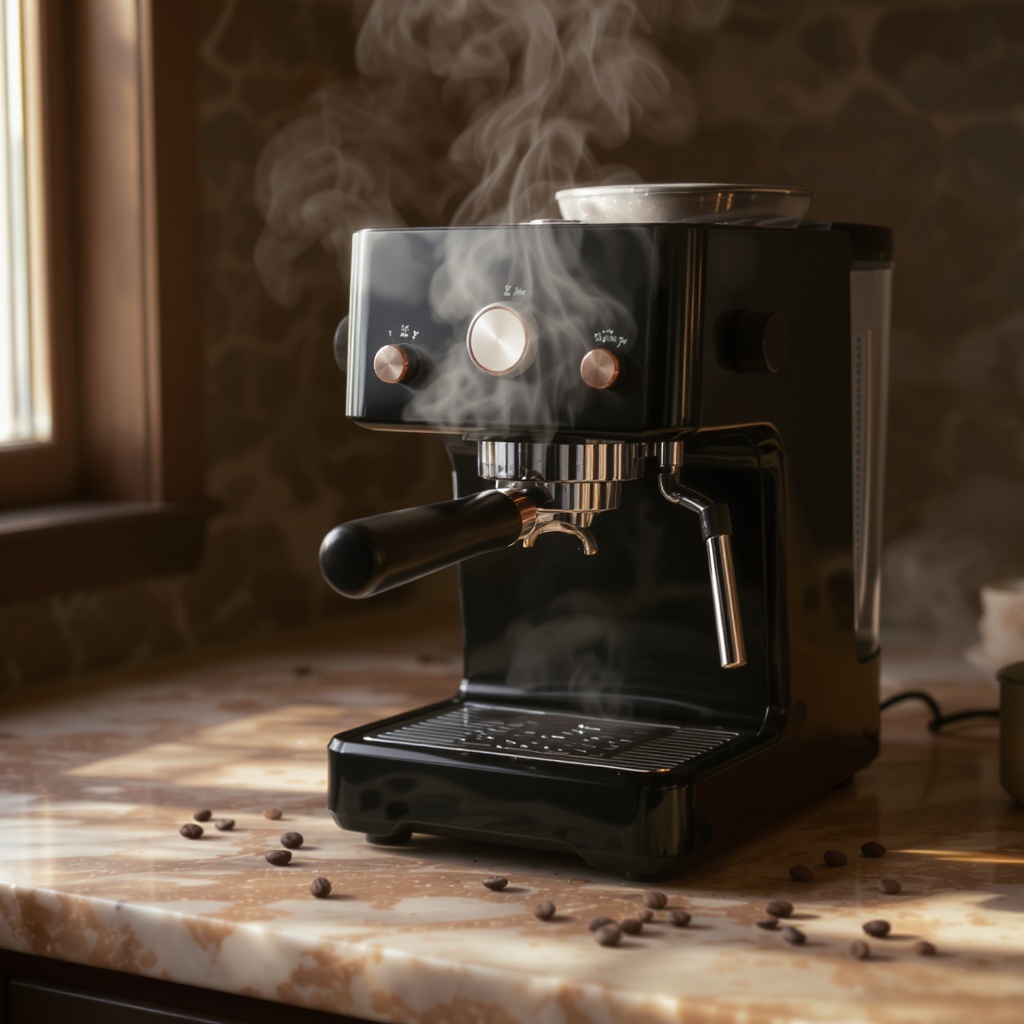
Built-in grinder removes the biggest upfront cost. PID-controlled thermal stability is genuinely good. Steam wand produces real microfoam.
Specifications at a glance
| Model | Breville Barista Express (BES870XL) |
|---|---|
| Type | Semi-automatic espresso machine |
| Price (MSRP) | \$699 |
| Current Amazon range | ~$549–$649 (check live price below) |
| Pump pressure | 15-bar Italian pump |
| Heating system | Thermocoil with PID temperature control |
| Built-in grinder | Conical burr grinder, 18 settings |
| Water tank | 67 oz (2L), removable |
| Steam wand | Manual, 360° articulating |
| Pre-infusion | Adjustable |
| Pressure gauge | Yes, on group head |
| Dimensions | 12.5" W × 13.5" D × 16.5" H |
| Weight | 23 lbs (10.4 kg) |
| Warranty | 1-year limited |
| Colors | Brushed stainless steel, brushed bronze, Black Truffle |
We may earn a small commission if you buy through our link — at no extra cost to you.
The built-in grinder: genuinely useful
Most integrated grinders in espresso machines are more marketing than function. Breville's conical burr grinder in the Express is the exception. It uses 18 grind settings and a dosing mechanism that delivers a consistent dose into the portafilter.
The grind quality is acceptable for home espresso at this price range. It's not going to compete with a $400+ dedicated grinder like a Baratza Sette 270 or Eureka Mignon — the retention is higher and the step sizes are larger — but it gets the job done, and it eliminates the need to buy a separate grinder upfront.
The key thing to know: the grinder is dosed for single-wall baskets. If you upgrade to a bottomless portafilter or triple-shot baskets, you'll need to recalibrate your expectations on dose weight. For most beginners using the double-shot basket that comes with the machine, it works well out of the box.
Espresso quality: solid and consistent
The 15-bar pump and PID-controlled Thermocoil system produce stable extraction temperatures. Once the machine is warmed up (allow 15–20 minutes after powering on), shots are consistent shot-to-shot. The PID keeps temperature swings within a range that produces repeatable results — critical for dialing in your perfect shot.
Pressure profiling is fixed: the machine runs at extraction pressure that the pump delivers. You can't manually override this, which limits how much you can experiment with pressure profiling. For beginners, this is fine — the defaults work. For experienced home baristas who want full control, it's a limitation.
The pre-infusion function is adjustable via a manual override setting. For light roasts, extending pre-infusion improves extraction. For darker roasts, shorter pre-infusion avoids over-extraction. Most beginners won't touch this setting for months — and that's fine.
In practice: a well-dialed shot from the Barista Express tastes genuinely good. Not café-quality-in-a-single-moment good, but properly extracted and balanced. The crema, when the dose and grind are right, is thick and reddish-brown. It's satisfying to drink.
Steam wand: better than most at this price
The steam wand is one of the Barista Express's strongest features relative to competitors in the same price bracket. It's a manual wand with a 360° articulating tip — meaning you can position it at different angles in the pitcher for different types of foam.
It produces dry steam (water content vs. wet steam), which is what you want for microfoam that pours well for latte art. The power is sufficient for pitchers up to 12 oz — more than enough for most home use. You'll need to practice the technique (tip placement, immersion depth, swirl motion), but once you learn it, the results are genuinely good.
The catch: the Thermocoil heating system requires a ~5–10 second pause between pulling a shot and steaming. You can't pull a shot and immediately steam. For making a single latte at a time, this is fine. For making multiple milk-based drinks in quick succession (say, two cappuccinos for you and a partner), the pause adds up and you need to plan around it.
Build quality: built to last with care
The Barista Express is primarily stainless steel and solid plastics. The group head is commercial-grade chrome-plated brass, which retains heat well and contributes to thermal stability during extraction. The drip tray is large and easy to clean. The portafilter is heavy, which helps with consistent tamping.
The main plastic components (water tank lid, buttons, knob) feel durable enough but aren't the same grade as the external steel. That's typical for machines in this price range. With reasonable care, the machine lasts 5–10 years for most home users. Common failure points: the solenoid valve (for backflushing) and the pump (after heavy use). Both are replaceable parts widely available from Breville.
One genuine frustration: the wand mount is a screw-in design, not a quick-release. You can't easily swap to a third-party steam tip. Not a dealbreaker, but worth knowing if customization is important to you.
Value: worth it, but wait for a sale
The Barista Express retails for $699 MSRP, but Amazon pricing regularly drops to $549–$649. If you're seeing it at $549 or below, it's a strong value — you're getting a machine with genuine capability at a price that doesn't punish you for not knowing what you're doing yet.
At $649+, it's still fair. You're paying for the brand, the parts availability, and the community support. The machine will hold its value on the secondhand market better than most competitors.
What you get for that price, compared to buying a separate machine and grinder: the Express undercuts the combination of a Gaggia Classic Pro ($749) plus a Baratza Encore ($169) by roughly $200 — and takes up half the counter space. The tradeoff is that neither component is as good individually. But for a beginner who doesn't yet know whether they'll stick with espresso, that $200 cushion matters.
Breville runs sales frequently on Amazon. Sign up for price alerts or wait 2–3 weeks and you'll likely catch it below $600.
Pros & Cons
- Best built-in grinder at this price
- PID-controlled temperature for repeatable shots
- Steam wand produces genuinely good dry steam
- Commercial-grade brass group head
- Available under $600 on Amazon regularly
- Strong community support for troubleshooting
- 5–10 second pause between shot and steam (Thermocoil)
- Grinder retention higher than dedicated grinders
- Fixed pressure — no manual profiling
- 15–20 minute warm-up time
- Steam wand is screw-mount, limits tip customization
- Heavy at 23 lbs
Who it's for
- New to home espresso, wants one machine that does everything
- Doesn't already own a dedicated grinder
- Willing to learn the craft (not one-button espresso)
- Makes 1–4 espresso drinks per day
- Wants genuine milk-steaming without spending $1,000+
- Wants one-button operation (look at Oracle Touch)
- Already owns a quality grinder
- Making more than 4 espresso drinks in one session
- Wants full pressure profiling control
- Limited counter space
How it compares
| Barista Express | Barista Pro | Oracle Touch | Gaggia Classic Pro | |
|---|---|---|---|---|
| Price (MSRP) | $699 | $849 | $1799 | $749 |
| Built-in grinder | Yes | Yes | No | No |
| PID temperature | Yes | Yes | Yes | No |
| Steam wand | Manual | Manual | Automated | Manual (commercial) |
| Pre-infusion | Adjustable | Adjustable | Automated | Manual via solenoid |
| Best for | Beginners wanting one machine | Intermediate users who want faster heat-up | Zero-learning espresso households | Manual purists on a budget |
Final verdict
Built-in grinder removes the biggest upfront cost. PID-controlled thermal stability is genuinely good. Steam wand produces real microfoam.
The Breville Barista Express (BES870XL) is worth serious consideration in the espresso machine space. The verdict: Buy it if the use case fits.
Common questions
Does the Breville Barista Express have a built-in grinder?
Yes. The Barista Express has a built-in conical burr grinder with 18 grind settings. You don't need a separate grinder to start making espresso.
Can you steam milk with the Breville Barista Express?
Yes. The Barista Express has a manual steam wand that produces dry steam for latte art and microfoam. It takes practice, but the wand is genuinely capable once you learn the technique.
Is the Breville Barista Express good for beginners?
Yes — if you're willing to learn. The built-in grinder and pre-programmed shot buttons lower the barrier to entry. But pulling good espresso requires understanding grind size, dose, and tamp. It's simpler than fully manual, but not a one-button appliance.
What is the difference between the Barista Express and Barista Pro?
The Express uses a Thermocoil heating system (5–10 sec pause between shot and steam). The Pro uses ThermoJet (3-second heat-up, near-instant shot-to-steam). The Pro also has an LCD display. The Express is cheaper by ~$150.
How much does the Breville Barista Express cost?
The BES870XL retails for $699 MSRP. On Amazon it typically sits around $549–$649 depending on promotions. Breville runs sales frequently — buying at full price is rarely necessary.